

The Career Trade-Off Decision Matrix
The hardest decisions aren’t right or wrong. They’re trade-offs.
This matrix makes the trade-offs visible and produces a choice you can stand behind.
What This Is
The Career Tradeoff Matrix is a simple scoring tool for comparing two or three realistic options.
It doesn’t tell you what to choose.
It shows you what you’re actually prioritizing.
When choices look attractive for different reasons—more pay, more stability, more growth, better lifestyle—it’s easy to circle.
This forces the trade-offs into the open. Matrix when trade-offs matter more than absolute right or wrong answers.
How It Works
Name your options (e.g., stay in role, pursue new opportunity).
Weight five factors: Compensation, Stability, Growth, Lifestyle & Strategic Positioning
Score each option 1–5. The sheet calculates the totals.
Using the same criteria for each option makes the trade-offs visible.
Example: Stay in Biotech or Move to Big Pharma
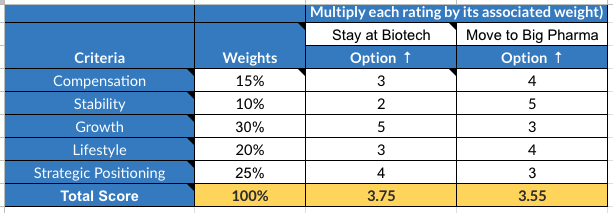
The matrix didn't tell her what to choose. It showed her what she was actually optimizing for—and why one path aligned better than the other.
A Senior Director in Clinical Operations was deciding between staying at a fast-growing biotech and joining a large pharma company.
On paper, pharma looked like the safer bet: more stability and higher compensation. But when she ran both options through the matrix, she could see exactly what she’d be trading for what.
How she weighted the criteria
Compensation (15%): salary, benefits, bonus, equity
Stability (10%): company runway and disruption risk
Growth (30%): meaningful stretch beyond what she already knew
Lifestyle (20%): pace, travel, hours, sustainability
Strategic Positioning (25%): whether this makes her more credible for her next level role
What the scoring revealed
Pharma scored higher on Compensation and Stability.
Biotech scored higher on Growth and Strategic Positioning.
The decision wasn’t “which job is better.” It was what she was choosing to optimize for.
Because she weighted growth and strategic positioning more heavily in this decision, staying at the biotech came out ahead.
The matrix didn’t make the decision for her. It made the trade-offs explicit—so she could choose intentionally.
When This Is Most Useful
Use the Career Tradeoff Matrix when:
You’re choosing between two roles that both look defensible.
You’re weighing security against acceleration.
You’re deciding whether to stay and reshape your role or pursue a move.
You feel stuck between “smart” and “safe.”
It works best when the trade-offs are real.
Frequently Asked Questions
Does the Career Tradeoff Matrix tell me what to choose?
No. It’s a weighted career decision matrix that helps you compare options and see what you’re prioritizing.
What if the total scores are very close?
That usually means the decision turns on risk tolerance, timing, or a factor you haven’t fully named. Try shifting the weights by 5–10% and see what actually changes the outcome.
What if I don’t know how to score something?
Score based on your current assumptions. If you’re unsure, write the assumption down and rerun the matrix if it changes.
Is the template free, and how do I use it?
Yes—this is a free Google Sheets decision matrix template. Click the link and make a copy (no email required). You can also download it as Excel.